Horse breed
Zwart als de nacht

Friesian horse

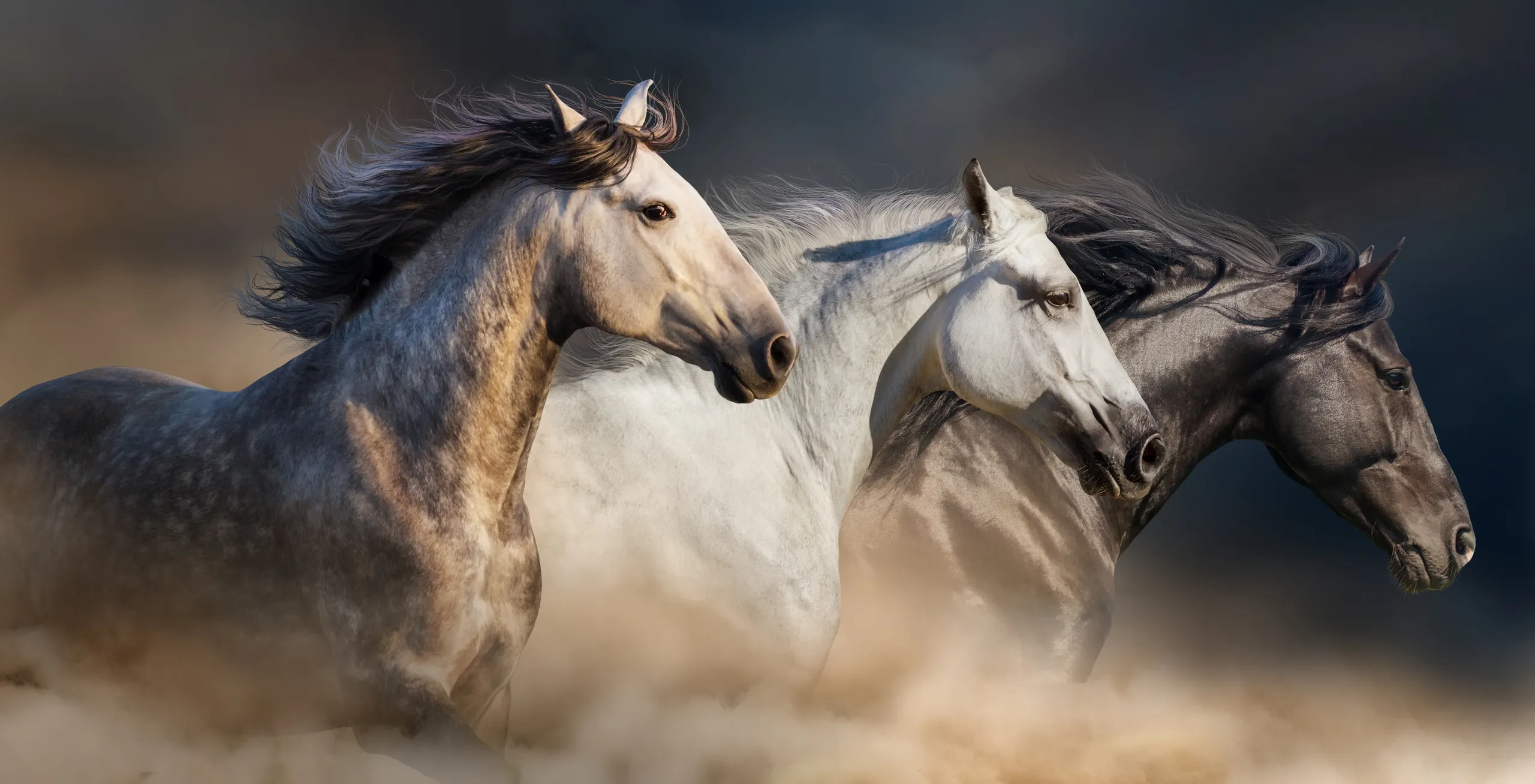
Horses galloping
Origin
Friesland (NL)
Height
155–170 cm
Colour
Black only
Studbook
since 1879
Life expectancy
25–30 years

Twice nearly lost

History

Medieval

Knight's mount

Already mentioned by Roman chroniclers; carried knights in full armour — a sturdy land horse of the Frisian marshes.

16th–17th c.

Baroque horse

Iberian blood introduces the arched neck and knee action — the Friesian becomes the court horse of baroque riding.

1879

Studbook

Foundation of the "Friesch Paarden-Stamboek" to save the pure type from the trotter craze.

1913

The low point

Only three purebred licensed stallions remain. A strict purebred programme saves the breed at the last minute.

Today

Global comeback

Around 80,000 registered Friesians in over 40 countries; the KFPS has held a Royal warrant since 1954.

The breed survived a second crisis in the mid-20th century — tractors displaced the working horse — thanks to leisure riding and spectacular show and film appearances.
Become our first partner stable for Friesian horse

Present your riding stable to an engaged equestrian audience — with a profile, logo, and direct link to your website.

Become a partner

Unmistakable

Appearance

Horses galloping

The neck

High-set and strongly arched — the most striking feature. Paired with a wedge-shaped, refined head and small, attentive ears.

The black

Only black horses are registered; the only permitted marking is a small star. In summer sun the coat fades to "summer black".

The hair

Often floor-length mane, dense tail, pronounced feathering — traditionally left uncut.

The body

Compact baroque horse: deep chest, well-placed shoulder, slightly sloping croup. 155–170 cm, 550–700 kg.

Baroque type

More compact, rounder, higher knee action, fuller feathering — the classic look for driving, shows, and baroque riding.

Sport type

Lighter, longer-legged, more ground-covering — bred specifically for modern dressage; today the direction preferred by the KFPS.

Gentle giant

Character

Exceptionally people-oriented, gentle and willing — "lively yet composed". Attentive under saddle, not easily spooked, and calm under pressure: a legacy of centuries as a war, work, and carriage horse.

Many Friesians actively seek closeness to their people and learn quickly — though with inconsistent handling they charmingly develop ideas of their own.

Gaits

"Black as the night, light as a feather in trot."

Trot

The trademark: high, cadenced, with pronounced suspension — often called "floating".

Walk

Industrious and elevated.

Canter

Uphill and powerful; the compact build limits ground cover — collection yes, speed work no.

Everyday life with a Friesian

Care & husbandry

Keeping & feeding

  • Easy keeper: hay, pasture, and minerals suffice for moderate work; avoid excess weight consistently.
  • Movement is mandatory: when confined, the breed tends to filled legs.
  • Cold-hardy, heat-sensitive: shade in summer, cool training times, clipping if needed.
  • Herd contact: group or open housing with dry footing — constant moisture promotes mud fever in the feathering.
Effort: high

Long-hair grooming

  • Mane & tail: hand-pick several times a week instead of brushing; often braided for riding.
  • Feathering: check daily for moisture and scabs — can mask mud fever and CPL.
  • Coat: groom regularly for the shine; summer sun bleaches — plan turnout times.
  • Hooves: hard and strong, trimming every 6–8 weeks.

From the arena to Hollywood

Uses

01

Baroque riding & haute école

Elevation, collection, expression — for centuries the horse for piaffe, passage, and baroque exhibitions.

02

Dressage

The sport type competes up to medium and advanced levels; some reach Grand Prix.

03

Driving

Crowd favourite from single to four-in-hand and in front of the traditional Frisian "sjees" carriage.

04

Show, film & TV

A regular in period and fantasy productions — from "Ladyhawke" to "Zorro" to "Game of Thrones".

05

Leisure & therapy

Calm and people-oriented — a reliable partner all the way to therapy work.

Less suitable

Endurance, long trail rides in heavy terrain, jumping — weight and heat sensitivity set limits.

Stricter than an MOT

Breeding

The mother studbook is the Koninklijk Friesch Paarden-Stamboek (KFPS) in Drachten, with branch associations in over 40 countries. Stallions pass a multi-stage licensing with conformation, movement, and veterinary exams plus a performance test — only a fraction of each year is approved.

Because the population traces back to few founders, the KFPS actively manages pairings: published inbreeding and kinship values help keep the genetic base broad.

Ster

Above-average conformation and movement — awarded at shows from age three.

Kroon

Intermediate level for mares: very good scores plus a sport or IBOP performance record.

Model

Highest predicate for mares — conformation, movement, and performance close to the breeding ideal.

Sport

For proven success in dressage or driving competitions.

An honest look

Health

The narrow genetic base has left breed-typical risks. Responsible breeders test and select consistently against them — buyers should know them.

Genetic test ✓

Dwarfism

Recessively inherited; carriers are paired deliberately or excluded.

Genetic test ✓

Hydrocephalus

"Water head", recessively inherited and usually not viable — controllable via testing.

Not testable

Aortic rupture

Elevated risk of ruptures of the main artery — include a cardiovascular check in the pre-purchase exam.

Familial

Megaesophagus

Widening of the oesophagus with swallowing problems and choke.

Manageable

CPL & mud fever

Chronic swelling under the feathering — not curable, but well manageable with consistent care.

Broodmares

Retained placenta

Mares show retentio secundinarum more often than average — veterinary aftercare following birth matters.

With sound breeding and species-appropriate care, Friesians reach 25–30 years. An extended pre-purchase exam is particularly worthwhile with this breed.

What does the black pearl cost?

Buying & costs

The range depends on pedigree, predicates, training, and health status. Running costs match other full-size horses — plus the higher grooming effort.

When buying: verify KFPS papers, ask for the parents' genetic test status, and extend the pre-purchase exam to include cardiovascular diagnostics.

€3,000–7,000

Foal

€8,000–15,000

Leisure horse with basic training

€15,000–40,000+

Ster/Kroon mares & sport horses

Up to six figures

Licensed stallions & top horses

Hall of Fame

Famous Friesians

Goliath

Rutger Hauer's stallion in "Ladyhawke" (1985) — triggered the first international Friesian boom.

Tornado

Zorro's horse in "The Mask of Zorro" (1998), portrayed by Friesian stallions.

Friso

The Dutch royal family's Friesian — a fixture of royal ceremonies.

Uraeus

Friesian stallion alongside Charlize Theron in "The Huntsman".


3 → 80.000

Stallions in 1913 → horses today. One of the most remarkable comeback stories in horse breeding. The central task remains balancing popularity and health — with transparent genetic testing, a controlled inbreeding rate, and a breeding goal that combines expression and rideability.

A breed with genuine celebrity status — on screen and in the show ring.

Riding stables & barns for Friesian horse

We're building a directory of riding stables, barns, and yards around Friesian horse. Sign up and we'll let you know as soon as the first stables are listed.

Profile: Friesian horse

All figures are editorial reference values.
Origin
Friesland, Netherlands
Height
155–170 cm
Colour
Always black (rappe)
Weight
550–700 kg
Studbook
Founded 1879 (KFPS)
Life expectancy
25–30 years
Types
Baroque & sport type
Trot
High, cadenced, floating
Main uses
Driving, shows, baroque riding
Temperament
People-oriented, willing, calm
Long hair
Abundant mane, tail & feather
Population
~80,000 in 40+ countries

Was this page helpful?

Sources & associations

Good to know

Frequently asked questions

Answered briefly by our editorial team. Missing your question? Write to us.